
What cutting-tool research can tell a machine shop before a production trial
A research paper can identify a promising cutting-tool design without proving that it will lower the cost of a finished part. The useful work for a machine shop begins with separating the measured result, the simulated result and the production question that remains unanswered.
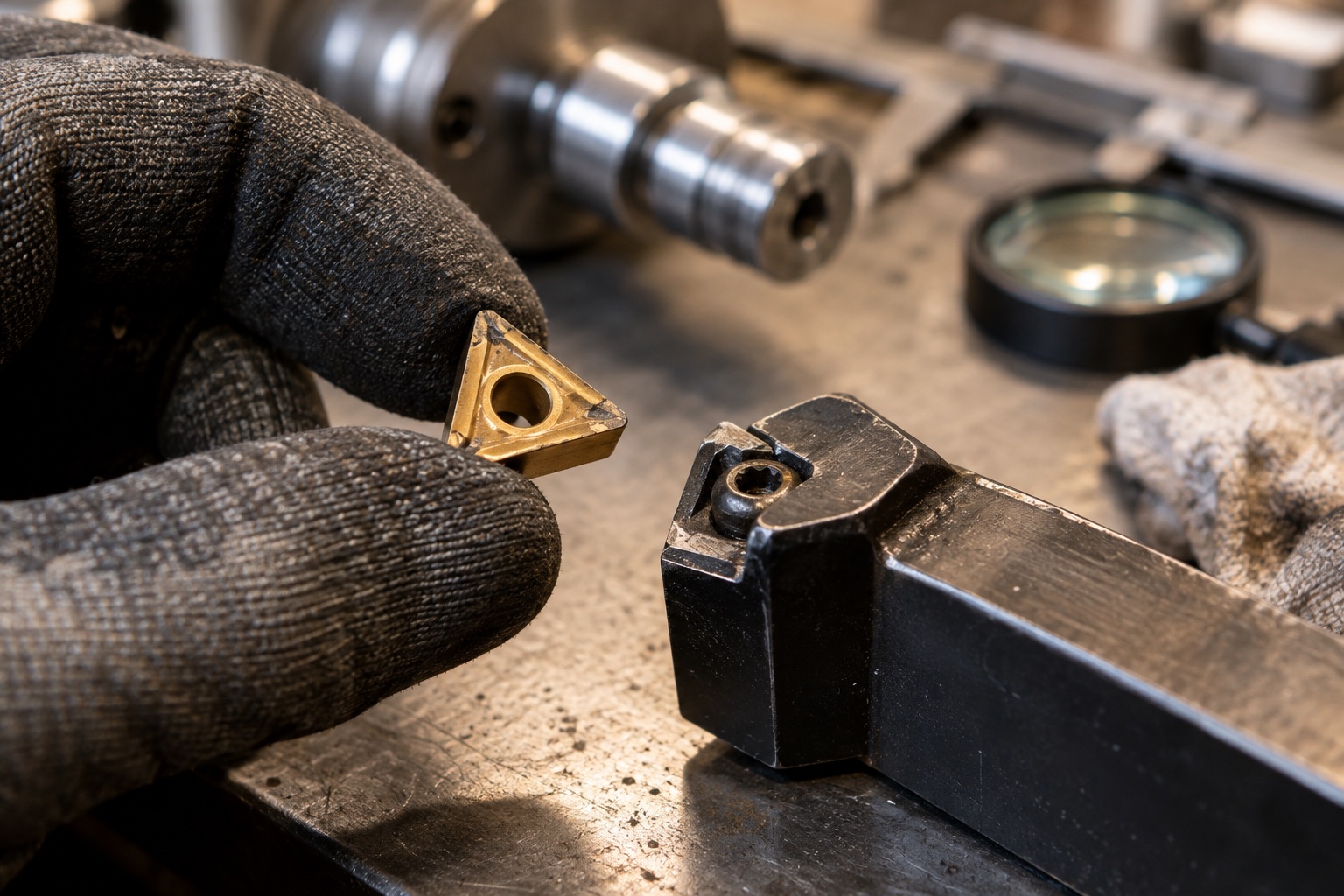
As of April 23, 2025. A study by Tiantian Xu and colleagues, published in Mechanical Sciences on April 9, investigates coated micro-textured tools for aluminium alloys. It combines physical cutting tests with theoretical analysis and finite-element simulations. Its conclusions about the relative performance of textured and coated designs include simulation results. Reading that distinction matters more than lifting an improvement percentage from the abstract. The paper is a useful reason to examine how a tooling claim should travel from research to the shop floor. A promising mechanism can justify a carefully designed trial. It cannot, by itself, determine the right insert, process setting or replacement interval for a different machine and workpiece.
Identify what the experiment actually measured
In the physical test section, Xu and colleagues describe dry turning of aluminium bar, force measurement and repeated surface-roughness measurement. Later sections compare tool designs through simulation. These are different forms of evidence, with different limitations. Neither should be presented as an observed reduction in a customer's cost per accepted part.
A shop reviewing any similar paper can start by writing down the operation, workpiece material, tool geometry, lubrication condition and measured output. If those details differ from the proposed application, the difference becomes a question to test. It should not disappear inside a general claim that the research concerns the same metal.
A reduction in cutting force, for example, is not automatically a longer usable tool life. Tool life also requires a defined end condition and observations over time. A result for surface finish does not establish dimensional stability across a production run. Each metric answers a narrower question than the phrase better performance suggests.
This does not make laboratory research unhelpful. It makes the route to application clearer. The paper supplies a hypothesis about a mechanism or design choice. The machine shop supplies the operating conditions, quality requirements and commercial test that determine whether the hypothesis is useful locally.
Diagnose the present limitation before choosing a solution
A tooling change is easier to evaluate when the current problem is described precisely. Is the shop replacing tools because of progressive wear, occasional edge failure, unacceptable finish or a conservative time interval? Those situations may lead to different trials and different definitions of success.
Seco's technical guide distinguishes wear patterns such as built-up edge, chipping and thermal damage. It is supplier guidance and should be used as diagnostic background, not as independent proof for a product purchase. Its practical lesson is that the appearance and mechanism of deterioration deserve attention before a remedy is selected.
Sandvik Coromant's earlier aluminium-machining presentation also discusses the relationship between application, tool design and stability. This is manufacturer advice, rather than a controlled comparison across competing products. It reinforces the need to describe the machining task in detail. Seco and Sandvik belong to the same corporate group, so their guidance should not be counted as two independent confirmations.
An illustrative shop might discover that most rejected parts follow an occasional unstable cut, rather than gradual insert wear. A coating trial designed only around average cutting time would then miss the main problem. The first useful measurement would be the frequency and circumstances of the instability, together with the resulting quality loss.
Build a fair comparison with a clear endpoint
NIST's engineering statistics handbook places objectives and process-variable selection before the choice of experimental design. That order is useful for a tooling trial: define the question before deciding how many parts to machine or which data to collect.
For a simple comparison, a shop could hold the part program and material specification constant while comparing the existing and candidate tools. If it also wants to change speed or feed, the trial should distinguish the effect of the tool from the effect of the setting. Otherwise, an apparent gain may have several possible explanations.
The endpoint needs to be set before the results are known. It might combine an agreed wear condition with part-quality acceptance criteria. Operators should record why each edge was removed. An insert changed after a planned interval and one removed after an unexpected failure should not be treated as equivalent observations.
Variation between material batches, machines or shifts can complicate the comparison. A suitable experimental design can distribute or account for that variation, with support from someone familiar with the process and the analysis. Merely running the old tool on one day and the new tool on another leaves more room for unrelated changes to influence the result.
The trial should also retain unsuccessful runs unless there is a documented reason to exclude them. Removing inconvenient outcomes after the fact makes a comparison look cleaner while weakening its usefulness for production planning.
Monitoring research needs a realistic transfer test
A separate December 2024 preprint on milling-tool wear investigates a single-sensor approach using a sensor integrated into a toolholder. The researchers use two machines and discuss keeping complete tool-life runs separate between training and validation. This guards against a model being tested on data too similar to what it learned from.
The study concerns a defined milling setup and wear classification. It is a preprint, and it should not be read as proof that one trained model will work across all machines, materials and tool geometries. Its test design is useful because it asks what happens when the application changes.
For a shop considering monitoring software, the corresponding question is whether the supplier has evaluated the proposed operating conditions. A strong demonstration on a familiar dataset may still leave the customer's application untested. The acceptance process should include the actual decisions the monitoring system will influence.
An illustrative system that labels an edge as worn needs to be judged by the timing and consequence of that label. Early warnings may increase tool consumption. Late warnings may allow unacceptable parts. A high overall classification score can conceal a poor balance between those outcomes, particularly when most recorded cutting time is uneventful.
Calculate value at the accepted part
The commercial comparison should include more than the insert's purchase price or the maximum number of minutes it cuts. A useful local model would account for accepted output, tool changes, inspection, rework and interruptions attributable to the tooling arrangement. The chosen boundary should be the same for both alternatives.
Consider an illustrative trial in which a candidate edge lasts longer but needs more frequent inspection. That may still be worthwhile, but the inspection time belongs in the comparison. Another candidate might reduce cycle time while producing more variable finish. Its value depends on the acceptance rate and downstream consequences, rather than on cycle time alone.
Production teams should also distinguish repeatable results from a best run. A supplier and customer can agree what evidence is needed before widening a trial, moving to another machine or changing the approved process. This turns an interesting result into a controlled learning sequence.
The most useful outcome is not always immediate replacement of the current tool. A trial may show that the candidate works well for one part family, that the existing tool remains preferable elsewhere, or that another process limitation dominates. Each finding can improve purchasing and engineering decisions if it is recorded with its conditions.
Research offers machine shops a disciplined way to explore new designs. Its value grows when readers preserve the boundary between simulation, experiment and production, then test the question that matters to their own operation. The claim worth trusting is the one that survives a fair comparison at the required part quality.