
New versus used equipment in a changing market
A softer used-equipment market can create buying opportunities, but a falling index cannot tell a contractor whether a particular machine is good value. The useful comparison starts with equivalent capability and ends with the cost of putting dependable equipment to work.
As of August 19, 2025. Recent US construction-equipment reports show why the distinction matters. Different categories and sales channels are moving at different rates. New-equipment producer prices, dealer asking values and auction results describe related markets, but they measure different transactions. Reading them together is more useful than searching for a single headline declaring that machinery is cheap or expensive.
The used market is moving unevenly
Sandhills Global's August 6 report shows US used heavy-duty construction-equipment inventory on its platforms down 7.72% from a year earlier in July. Asking values fell 3.12% over the same period, while auction values declined 0.63%. The figures cover Sandhills' market observations and its Equipment Value Index; they are not a census of every machine offered or sold in the United States.
The gap between asking and auction movements is a useful warning against treating a listing as a completed transaction. A seller's advertised expectation and the result of a particular sales process can respond differently to market conditions. Inventory changes also require care: fewer advertised machines may reflect sales, withdrawals or changes in the composition of the available fleet. They do not alone prove a shortage of the specification a buyer needs.
For procurement, the next step is to narrow the comparison. A compact excavator and a large production excavator serve different jobs. Even within one size class, age, operating hours, attachments and maintenance condition can affect the offer. A market index can frame a negotiation, but the relevant evidence is a set of comparable machines available within the required geography and delivery period.
Auction and retail prices answer different questions
Ritchie Bros.' August 5 summary of its July market report describes mixed second-quarter auction pricing across the United States and Canada. Its US construction mix-adjusted price index was about 1% lower than in the first quarter, while its summary of Rouse US retail data showed construction prices approximately 1% higher. These observations come from different channels and should not be blended into a single percentage.
The contrast suggests that a buyer should examine what accompanies each offer. One transaction may include inspection information, preparation or a service arrangement; another may require the buyer to organize transport and address defects. Those terms must be confirmed for the actual machine. It would be equally mistaken to assume that every dealer offer includes strong protection or that every auction asset carries the same level of uncertainty.
A written comparison should specify the delivered configuration, inspection access, collection deadline and known work required before use. The headline price then becomes one component of an intelligible offer. If a buyer cannot establish those details, the apparent discount remains an unanswered question. A low price with an undefined scope is difficult to compare with a higher price that includes a clearly documented package.
New-equipment signals need their own interpretation
The Bureau of Labor Statistics' July producer-price release, published on August 14, reports prices across detailed machinery categories. It also notes a 3.8% monthly increase in margins for machinery and equipment wholesaling within its final-demand discussion. That margin measure is not a 3.8% increase in the selling price of every machine. Confusing the two can distort a purchasing discussion.
Producer-price series are useful for understanding broader price pressure. A current quotation remains necessary to establish what a particular new machine costs, including its configuration and commercial terms. Likewise, a lower used-equipment index does not establish the discount to an equivalent new machine. The two offers need to be collected at roughly the same time and compared on a consistent basis.
This also prevents an obsolete list price from exaggerating the attraction of a used asset. The relevant alternative is the new equipment actually available to the buyer, with its actual delivery date and specification. A machine that cannot arrive before a committed job begins may be a poor operational substitute, even if its eventual ownership economics look attractive on paper.
Condition can outweigh the market movement
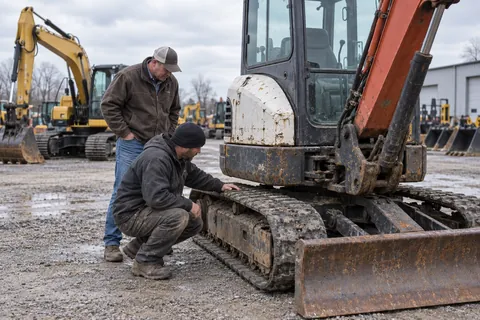
An illustrative buyer considering two used excavators might find similar model years and operating hours but very different service histories. One may have documented component replacement and a clear inspection record. The other may require further investigation before its near-term maintenance needs can be estimated. These are hypothetical examples, but they show why hours are a screening variable rather than a complete measure of condition.
The buyer should identify the uncertainties that could change the decision materially. Questions about hydraulic performance, undercarriage wear, structural repairs or attachment compatibility belong with a suitably qualified inspector. The aim is to convert unknowns into documented observations and priced work. It is not to turn a general market article into a substitute for a machine-specific technical assessment.
Inspection also has a timing value. Finding a problem before bidding preserves the option to walk away or adjust the offer. Finding it after collection may require cash immediately while the machine earns nothing. A buying process that reserves time and budget for investigation can therefore be more useful than trying to predict the next small movement in an aggregate index.
Financing sentiment does not establish affordability
The Equipment Leasing & Finance Foundation's July confidence index rose to 61.6 from 58.2 in June. The survey is a qualitative assessment from equipment-finance executives. It indicates their view of business conditions, rather than an approval decision, interest rate or financing offer for a particular contractor.
For a buyer, affordability still depends on the actual deposit, repayment schedule and available working capital. A lower purchase price can be accompanied by financing terms that change the cash requirement. The business must also retain enough capacity to fund mobilization, wages and repairs while waiting for customers to pay. Equipment ownership does not create cash merely because the asset has potential resale value.
Consider a hypothetical contractor choosing between a newer machine and an older unit with a lower initial price. If the older machine requires immediate work, the repair payment may fall before the first project receipt. A comparison based only on monthly installments would miss that requirement. The useful cash schedule includes purchase, preparation, transport and the period before the machine begins generating collected revenue.
Compare a consistent period of service
NIST's Investment Analysis Methods guide provides established background on comparing investment cash flows and testing uncertain assumptions. Its 2017 publication is a method reference, not evidence about current machinery demand. One relevant principle is to use a consistent analysis period, especially when alternatives have different expected service lives.
Applied to this market, the comparison should explain what happens if the used asset needs replacement earlier than the new alternative. It should also avoid counting an optimistic future resale value as if it were guaranteed. Testing more than one utilization and residual-value assumption makes the dependence on those estimates visible. This is a way to examine the choice, not a universal recommendation to prefer new or used equipment.
The strongest buying opportunity is therefore a machine that fits a defined workload, has a credible condition assessment and leaves the business able to absorb the obligations it creates. Market reports help establish whether the broader environment is strengthening or softening. Comparable offers, inspection and the delivery schedule establish whether that environment produces a useful purchase. When those pieces agree, a buyer can act with more confidence than a falling price headline alone can provide.
Source: Sandhills Global, July2025 used-equipment market analysis · Cover: AI-generated illustration