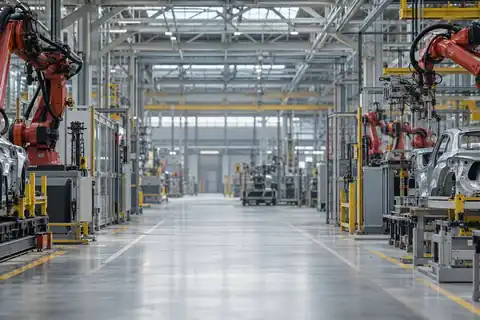
Machine vision for equipment guidance
Machine vision can help equipment interpret its surroundings, but a recognizable image is only one part of reliable guidance. The system must identify relevant objects, estimate position and distance, and support a decision that remains appropriate as the machine and environment change.
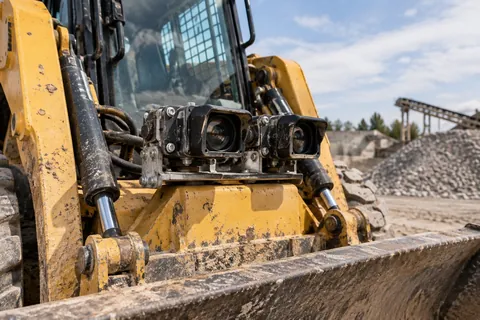
As of October 6, 2025. Recent outdoor robotics research shows why laboratory performance is an incomplete guide. Seasonal vegetation, poor visibility and the equipment's own moving parts can alter what sensors observe. These conditions deserve explicit attention when evaluating a vision-guided machine for industrial work.
A field experiment makes the limits visible
A September 2025 preprint from ETH Zurich and Gravis Robotics investigates boulder extraction using a standard excavator bucket. The system combines vision-based segmentation, sparse LiDAR measurements and feedback from the machine. Its policy was trained in simulation and then tested on a 12-ton excavator.
The authors report 70 percent success across their field trials, compared with 83 percent for human operators, for the tested rocks and conditions. These are task-specific research results, not a general rating for autonomous excavation. The study's value includes its account of failures, rather than only successful lifts.
Cabin-mounted sensors lost sight of small rocks behind the bucket, and partially buried rocks were difficult to represent fully. The authors identify perception and occlusion as major sources of unsuccessful trials. This directly connects camera placement and visibility to the completed machine action.
For an equipment buyer, the inference is to test the whole motion. A target that is clear at the beginning may become hidden later. The relevant question is whether the application can complete the intended task within its assessed conditions, including the stages when its own structure changes the view.
Recognizing terrain is different from crossing it
Carnegie Mellon's AirLab describes research that learns off-road traversability from both external sensing and the vehicle's experience. Its March 2025 project account explains why appearance and height alone can be misleading. Tall grass and a rigid obstacle may look similarly obstructive in a simple geometric representation while producing different vehicle interactions.
The research uses information such as vehicle motion and inertial measurements to help interpret terrain. Its reported trials concern particular research platforms and courses. They should not be transferred directly to a loaded industrial machine with different tires, ground clearance or operating requirements.
The broader lesson is to separate object recognition from operational suitability. A camera might correctly label a surface without establishing whether a particular machine can traverse it under the current load and ground conditions. Guidance needs the relevant relationship between perception, vehicle capability and the proposed action.
An illustrative loader evaluation would therefore consider its intended configuration and operating area. A demonstration on a dry, unloaded route would provide limited evidence about a different application. The comparison should state which conditions were represented and which still require assessment by the equipment supplier and responsible operating team.
Outdoor localization changes with the season
The ROVER dataset, described by its research team and IEEE in June 2025, evaluates visual localization and mapping in natural, partly structured environments. It contains 39 recordings across five locations, covering seasons and lighting conditions including daylight, dusk and night. Its contributors include Esslingen University, Freiburg University and STIHL.
The reported benchmarks show difficulties in low light and dense vegetation, particularly in summer and autumn. The dataset concerns localization and mapping research, not a certification that a commercial machine can operate safely in every outdoor workplace. Its usefulness lies in testing environmental variation systematically.
This matters for equipment that returns to a route over time. A scene may remain the same place while its visible features change. Growing vegetation, shadows and seasonal appearance can affect the evidence available to an image-based localization method. A commissioning trial should consider the period over which the system will be expected to work.
For a hypothetical outdoor storage operation, testing only one clear afternoon may miss a relevant low-light shift. The appropriate test conditions depend on the proposed operating schedule. The aim is to represent that schedule faithfully, not to demand performance in conditions where the equipment will never be used.
Visibility tests need more than one average score
A Federal University of Bahia doctoral thesis completed in July 2022 and deposited on arXiv in September 2025 examines visual perception for off-road vehicles. It evaluates segmentation under different visibility conditions and discusses deployment on embedded computing hardware. The research date matters: the new repository deposit does not make the underlying experiments new.
Its discussion reports degraded segmentation under extreme visibility conditions and identifies classes too rare in the dataset for meaningful testing. This limits how broadly an overall result can be interpreted. A model's performance on common terrain cannot establish its ability to recognize every uncommon obstacle.
For a buyer, that suggests reviewing results by relevant condition and object type. An average can hide a weakness in the very situation that matters to an application. The proposal should make clear how the evaluation sample represents the site and where evidence is sparse.
A useful illustrative acceptance table would separate daylight and intended low-light operation, clear and partially obstructed views, and the object categories the system needs to handle. The exact categories belong to the application assessment. Reporting them separately makes the evidence easier to interpret than a single headline percentage.
Measure guidance against an independent reference
NIST's earlier research on automated guided vehicle navigation describes comparing vehicle performance with ground-truth measurements. Published in 2015, it concerns experimental evaluation and proposed test procedures, rather than a contemporary outdoor product. Its relevance is the measurement principle: the system's own estimate should not be the only reference used to judge that estimate.
For an equipment trial, an independent position or task reference can help distinguish a convincing visualization from a correct result. The appropriate measurement method depends on the application and required precision. The test should document how the reference was established and what uncertainty it introduces.
An illustrative example is a system that displays a target location on a screen. A smooth, stable marker may look reassuring while remaining offset from the actual target. Comparing it with an independently checked position answers a different question from simply observing that the display updates without interruption.
The final task also needs assessment. A localization error, delayed image or missed object may affect different applications in different ways. Performance reporting should connect those measurements to the intended guidance function, while preserving any limits identified by the supplier's application and safety assessment.
Treat the sensing arrangement as part of the machine
The physical installation deserves attention alongside the software. The camera's view, mounting position and relationship to moving equipment should match the arrangement used in validation. If the installation changes, the operating team needs a defined process for deciding what must be checked again.
Maintenance is another practical question for procurement. The supplier should explain how the system identifies unavailable or unsuitable sensor information and what the operator is expected to do. The answer belongs in the documented operating arrangement, rather than being left to improvised workarounds during a busy shift.
As an editorial trial recommendation, record interventions and the conditions that caused them. A system that frequently requires help may still have a useful role, but that role should be reflected in staffing and throughput assumptions. Removing intervention time from a productivity calculation would describe a different operation from the one the buyer will actually run.
Recent research demonstrates progress in outdoor perception and machine guidance while making its boundaries more visible. The strongest equipment evaluation follows that example: test the real task, retain failures in the record and identify the conditions under which the result holds. Reliability comes from the complete sensing and operating arrangement, supported by evidence that matches the intended work.
Source: ETH Zurich and Gravis Robotics, Boulder excavation research2025 · Cover: AI-generated illustration