
Digital twins and the connected factory
A digital twin earns its place in a factory when a synchronized model improves a specific operating decision. A detailed three-dimensional display can help people understand a process, but visual realism alone does not show that the model predicts the right outcome or remains aligned with the equipment.
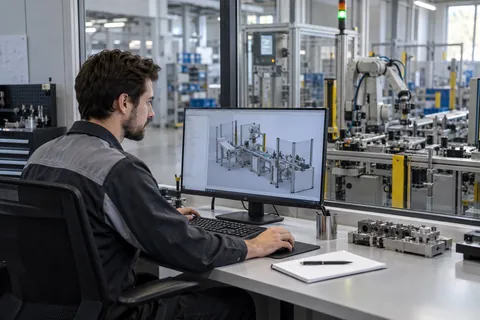
As of September 12, 2025. NIST's August 2025 report on its Digital Twin Laboratory provides a useful reference. It describes the physical workcell, data infrastructure and research needed to connect manufacturing equipment with digital representations. The report makes the supporting work visible, rather than presenting the twin as a single software purchase.
What a connected model needs to represent
NIST adopts the ISO 23247 manufacturing framework, which connects an observable manufacturing element with a digital representation suited to its purpose. The laboratory includes machining, robot handling and dimensional inspection, supported by a data pipeline. It is a research testbed for standards and implementation, not evidence of a fixed commercial return.
The report's practical value lies in connecting equipment, measurements and models. It describes collecting and aggregating machine information, storing data and making it available to applications. Those activities establish what the digital representation can know about the physical workcell and how that knowledge reaches a decision tool.
For a manufacturer, the first question is therefore the decision. A team investigating a queue between two machines needs different information from one trying to predict a dimensional deviation. The proposed representation should include the variables relevant to that problem and avoid claiming a wider scope than its data support.
A useful project brief might state that the model will compare alternative production sequences for one product family. That is a bounded proposition that can be tested. A promise to create a complete replica of the factory leaves unresolved which decisions it supports, how accurate it must be and who will use the result.
Synchronization should follow the decision timescale
The University of Sheffield's AMRC white paper, Untangling the Requirements of a Digital Twin, offers earlier background on definitions and functionality. It distinguishes live connections, historical information and additional supervisory capabilities. Its terminology is a proposed framework, so it should not be assumed to match every vendor's use of the same labels.
The useful idea is that a model's relationship to the physical process must be explicit. A static design model, a regularly updated representation and a system that can influence operations offer different capabilities. A buyer should ask what is updated, from which source and at what interval.
As an illustrative comparison, a daily capacity-planning decision may not require every sensor value to stream continuously. A decision about a rapidly changing process may need much more timely information. The appropriate update rate follows the use case; more frequent data collection is not automatically more valuable.
The project should also define what happens when updates stop. A display that continues showing an old value can appear current unless the age of the information is visible. A practical acceptance test would check the behavior of the intended application when data are delayed, incomplete or unavailable, using a controlled test arrangement.
A battery-line study demonstrates decision support
A June 2025 preprint on dynamic line reconfiguration combines a system-level digital twin, a description of equipment capabilities, optimization and automatically generated simulations. Its case study uses data and plans from a real battery manufacturing line, covering 51 operations and several human and machine resource types.
The study evaluates disturbance scenarios in simulation, including slower work at a station. Its reported performance demonstrates the proposed computational framework under those assumptions. It should not be presented as a measured production improvement after a live factory adopted the recommended configuration.
This boundary makes the example more useful, not less. The model can compare options before the factory changes its arrangement. The next commercial question is whether the predicted improvement remains credible when actual changeover constraints, available skills and physical installation work are included.
For an illustrative factory application, a model might recommend moving an operation to another station to reduce a bottleneck. The responsible team would still need to confirm tooling, qualification, access and product-quality requirements. A mathematically feasible assignment is a candidate operating decision, not automatic authorization to change a process.
Validation belongs to the intended use
A model can be accurate enough for one purpose and inadequate for another. Predicting average daily output does not establish that it can forecast every short interruption. Matching a machine's displayed state does not establish that its internal process model predicts finished-part quality. The intended use should determine the evidence required.
A practical evaluation can begin by asking the model to predict outcomes that will be observed independently. Reserve suitable operating periods for that comparison and report where the predictions differ. If the model is repeatedly adjusted after each result, retain a further comparison that tests the updated version on new information.
This is an editorial testing recommendation, rather than a claim that every digital twin needs the same statistical procedure. The appropriate method depends on the process and consequence of the decision. The central requirement is that the team can explain what was tested and why that evidence supports the proposed use.
A simpler model should remain a legitimate comparator. If an existing scheduling rule or spreadsheet answers the decision reliably, the digital twin needs to demonstrate additional value worth its maintenance. That might be faster scenario comparison, better handling of changing conditions or improved traceability. The gain should be named and measured.
Standards can organize the implementation
ISO's May 2025 technical report, ISO/TR 23247-100, describes a digital-twin use case for monitoring and controlling semiconductor ingot growth. Its public abstract presents a systematic view and high-level design using the manufacturing framework. It is a use-case report, not a claim that every manufacturing process is already covered by an interchangeable implementation.
This example suggests a useful role for standards: providing structure for how the physical process, information and applications relate. It does not eliminate the need to identify local equipment signals, units, meanings and update behavior. Two systems can both provide a temperature value while measuring different locations or using different time intervals.
An integration review should therefore go beyond whether a connection works. It should establish whether the receiving application interprets the information correctly. An illustrative data record could retain the equipment identity, measurement time, unit and quality status alongside the value, making its meaning easier to check.
The same discipline supports later changes. If a sensor, machine program or product definition changes, the team needs to know which assumptions and interfaces may be affected. Without that ownership, an initially useful model can drift away from the process while continuing to produce plausible-looking outputs.
Trust includes the data and the operating boundary
NIST's February 2025 report on security and trust in digital-twin technology discusses the components, connections and cybersecurity considerations involved. It provides a framework for examining trust across the system, rather than treating the model as isolated from its data sources and users.
For a manufacturing decision, the practical implication is that access and authority should match the intended role. A tool used to explore scenarios has a different operating boundary from one allowed to send commands to equipment. The project should make that distinction clear and provide the appropriate review before expanding its role.
Ownership also has an economic dimension. Someone must maintain connections, investigate discrepancies and update the model when the process changes. A business case that includes only the initial build leaves out the work needed to keep the twin useful. The estimate should cover the expected operating life and a defined support arrangement.
The strongest connected-factory proposal starts with a decision that matters, then specifies the minimum representation and data needed to improve it. The 2025 research offers tools and examples for doing that work. Its value becomes tangible when the factory can demonstrate a better decision and explain why the model deserves continued trust.
Source: NIST, Digital Twin Lab2025 and manufacturing research · Cover: AI-generated illustration