Construction automation beyond the demonstration
Construction robots are beginning to produce useful evidence beyond short demonstrations. The strongest examples still concern specific tasks under identifiable conditions. A robot that prints coordinated layout, assembles a test frame or surveys a structure should be evaluated against the work it actually performs.
As of October 13, 2025. Research published this autumn offers a more informative discussion than a simple prediction of automated building sites. It shows where task performance can improve, how site coordination affects utilization and why measured results must be separated from estimates and laboratory findings.
A layout study with an important comparison limit
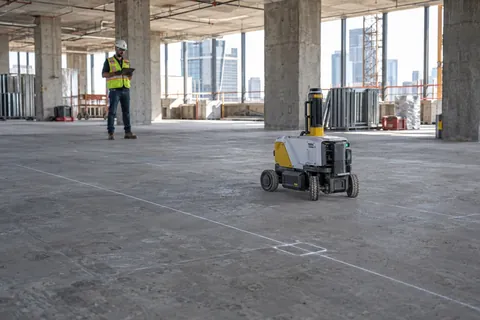
A September paper in Construction Robotics evaluates robotic layout at an eight-floor medical office building in Los Angeles. The authors include Stanford researchers and contributors from DPR Construction and Dusty Robotics. The study reports 68 percent fewer labor hours and an 18 percent reduction in layout duration relative to its estimated traditional process.
That qualification is essential. Robot activity was recorded, while the manual comparison relied on estimates and interviews because the project primarily used robotic layout. The paper explicitly identifies this limitation and says direct savings to the general contractor were indeterminate. Its percentages are case-study results under stated assumptions, not guaranteed savings for another project.
The analysis also found that high utilization occurred on fewer than half the robot's operating days, using a threshold of at least six operating hours. Weather, conflicting work and delays by other trades affected availability. The resulting lesson is about the project around the machine: a capable robot still needs a work area that is ready.
Decide which work has actually been automated
Layout provides a clear example of a bounded task. The machine transfers coordinated information onto a physical surface. It does not settle unresolved design decisions or independently establish that the supplied file is the approved construction information. The project still needs a reliable way to release and check that information.
For an illustrative tender comparison, a contractor could define the scope as a particular floor and set of trades, with agreed information and acceptance criteria. Both the manual and robotic options would include preparation, setup, checking and correction. That scope is more useful than comparing a robot's fastest printing pass with a crew's entire working day.
The same principle applies to other tasks. Drilling, scanning and handling require different inputs and create different outputs. An improvement in one operation may be valuable without changing the duration of the whole project. A buyer should identify the downstream activity that benefits and the conditions under which that benefit reaches the schedule.
This also helps interpret labor claims. If automation reduces repetitive marking but adds file preparation or coordination work, those changes should be counted together. The result may still be attractive, but the reason will be clearer than a statement that a robot simply replaces a certain number of people.
Controlled assembly helps isolate coordination questions
Monash University's September account describes a human-robot collaboration trial using a robotic arm and a mobile robot in a simulated timber floor-frame assembly task. Researchers examined task sequencing, allocation and physical strain. The work provides evidence about an arranged test activity, rather than a completed commercial building project.
Its contribution is to focus attention on how work is divided. A robot may perform an individual movement consistently while the combined operation suffers from waiting or awkward handovers. Improving collaboration therefore involves the sequence and workstation, as well as the robot's own motion or handling capability.
For a hypothetical repetitive assembly operation, a contractor could compare two sequences using the same people, parts and equipment. One might leave a worker waiting while the robot completes every handling step; another might allow useful parallel work within the assessed arrangement. The purpose would be to measure the complete task, not to assume that either sequence is better.
Such controlled trials are valuable because they can identify a problem before a more expensive site deployment. Their limitation is equally useful: a tidy experimental work area does not contain every interruption, access restriction or material variation of a live project. The next trial needs to test the assumptions most likely to change.
Large physical demonstrations answer a different question
ETH Zurich's earlier dry-stone construction project showed an autonomous excavator assembling a wall six metres high and 65 metres long. The university's November 2023 account describes scanning available stones and planning their placement. This is substantial physical construction evidence, and it is relevant background to the current discussion.
It is not evidence that a general-purpose excavator can autonomously perform every earthmoving or building task. The research system, material-handling method and planned wall were specific. A reader should preserve those conditions when comparing the result with a conventional site requirement.
The distinction matters because scale can be visually persuasive. A large completed structure demonstrates more than a tabletop experiment, but size alone does not establish routine availability, support requirements or performance across different projects. Commercial readiness needs evidence about repeated operation and the organization needed to keep it working.
For an equipment buyer, the useful follow-up would concern task repetition, interventions and the range of materials successfully handled. A supplier should be able to explain where the method has been tested and what remains outside that evidence. This creates a more realistic evaluation than assuming that a striking finished object proves a universal capability.
Inspection automation includes the route to the data
BAM's April 2024 account of modern construction methods describes a remotely controlled robotic dog carrying customized scanning equipment at a Shetland site. Its role was collecting information and creating records, with control through a 5G connection. This is a contractor's account of deployment, not an independent productivity audit.
The example shows why autonomy levels should be described accurately. Remote operation, autonomous navigation and automated analysis are different capabilities. A project may gain value from one without having all three. A procurement brief should state which part of the information-gathering process is expected to change.
Carnegie Mellon's October 2025 research account focuses on drones navigating around construction-site objects and people. It describes combining camera and radar information and using simulation to train collision-avoidance behavior. The account explains the research direction, but it does not establish a measured reduction in accidents across commercial sites.
Together, these examples suggest a complete inspection workflow to evaluate: acquiring the information, moving through the site, checking data quality and delivering something a project team can use. An automated route has limited value if the resulting survey arrives too late or cannot answer the intended construction question.
Design a deployment trial around everyday constraints
A useful site trial begins with an explicit baseline and a comparable scope. Record the quality of the incoming information, the readiness of the work area and the acceptance standard. Then observe the complete operation across enough ordinary working conditions to reveal interruptions as well as productive periods.
As an illustrative measurement plan, distinguish active task time from setup, travel, waiting and corrective work. Also record operator involvement. A robot that works quickly for a short window and a robot that works steadily through the day can produce different commercial results despite similar demonstration speeds.
The trial should make responsibility visible. Someone must prepare the input, release the work area, operate or supervise the equipment and accept the output. If a problem occurs at an interface, the project needs a way to resolve it without leaving the machine idle while several organizations assume another is responsible.
The autumn research supports a practical form of construction automation: selecting a defined task, preparing its inputs and measuring its result in context. The opportunity is credible, but its size belongs to the complete working process. Contractors will learn more from a documented ordinary week than from the most impressive minute of a demonstration.