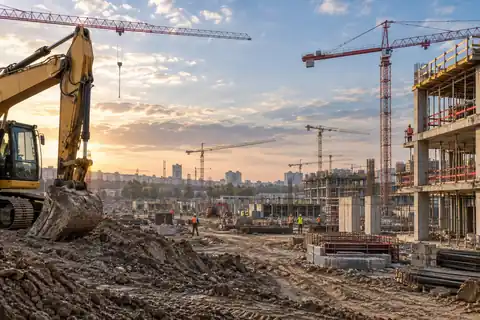
Modular construction: where factory production makes sense
Factory-built housing becomes compelling when repetition, a reliable order book and difficult site conditions reinforce one another. Moving construction indoors can change how work is organized, but the commercial result still depends on design decisions, transport and the connection between factory and site.
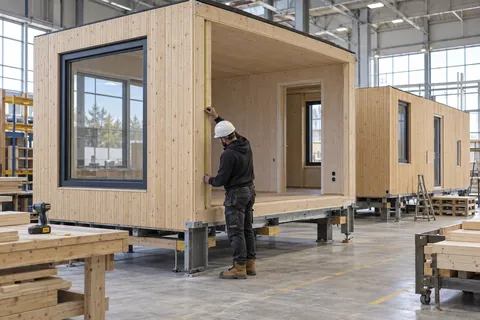
As of May 4, 2026. A Canadian housing case published in April illustrates the opportunity. It also provides a useful starting point for a broader question: which projects can turn manufacturing discipline into completed buildings, rather than simply shifting construction costs to a different address?
A northern project with a specific logistical problem
CMHC's April 24 account describes Arctic Modular Homes producing housing in Manitoba for communities in Nunavut. Its factory opened in February 2025. The first shipment of nine homes reached Cambridge Bay in September, with keys handed over in November. Those milestones show an operating delivery chain, not just a factory announcement.
The case addresses a particular combination of harsh weather, limited local construction capacity and demanding transport. Completing more work before shipment can reduce the amount that must happen at the destination. However, CMHC's account is a supported-project case study, not an independent comparison of identical modular and conventional developments. It cannot establish a universal cost advantage.
The useful inference is about project fit. A remote development with a short construction season may value a different combination of speed, predictability and site labor than an urban project beside a deep subcontractor market. Both can consider modular methods, but they should not be expected to produce the same business case.
Start with the building and its repeated elements
Singapore's Building and Construction Authority describes prefabricated prefinished volumetric construction as modules substantially finished offsite before installation. This is a specific form of offsite construction. It differs from transporting wall panels, precast components or a bathroom pod into an otherwise conventional building. Comparisons become misleading when all these methods are grouped under one productivity claim.
BCA's guidance emphasizes early integration of design, manufacturing and installation. For a buyer, that suggests evaluating the repeated unit before selecting the production method. Similar rooms, consistent structural interfaces and coordinated services offer a more plausible manufacturing opportunity than an order in which each unit requires different tooling and sequencing.
Repetition need not mean an identical appearance throughout a development. As an editorial design principle, a project could standardize hidden connections and service zones while allowing controlled variation in finishes. The important question is whether the variation changes the factory process. A different paint color and a relocated drainage connection have very different production consequences.
For an illustrative apartment scheme, the first comparison might therefore be between three room types that share a service layout and twelve types that do not. This is a hypothetical evaluation, not a measured saving. Its purpose is to reveal whether apparent repetition survives when the production drawings are examined.
Factory capacity needs a dependable pipeline
The 2025 rental housing development study commissioned by CMHC and conducted by EY received 109 responses through its outreach and survey process. Thirty-nine percent of respondents reported no plans to use modular or prefabricated construction. That is evidence of mixed adoption intentions among the respondents, not a representative estimate of every Canadian developer.
The survey matters because technical feasibility does not automatically create a steady order book. A producer needs work that can actually enter production. Announced housing targets, expressions of interest and projects awaiting finance should not all be counted as equivalent factory demand. A pipeline assessment should distinguish each stage explicitly.
Consider a hypothetical factory with an attractive quoted price at a planned production rate. If a customer's planning decision is delayed, the factory may have fewer units over which to spread its fixed costs. Alternatively, it may accept another order and no longer have the slot required by the first project. Neither outcome appears in a comparison limited to labor hours per module.
A developer evaluating a supplier can therefore ask how committed production is scheduled, what happens when a slot moves and how changes are priced. A manufacturer can test whether several projects share a platform or merely arrive under the same broad label. These are questions for the commercial evaluation, not evidence that a particular business is financially weak.
Design decisions move earlier
The independent volumetric construction research published by England's housing ministry in November 2024 examines potential safety and performance risks. The ministry explicitly says it does not measure their likelihood or prevalence, and the report is not a statement of government policy. It should not be interpreted as proof that modular buildings fail more often.
Its treatment of interfaces, inspection and responsibility nevertheless highlights a practical issue: a completed module can conceal work before it reaches the site. Factory records and clearly assigned inspection points become important parts of the handover. Checking only the visible finished surface at delivery would leave an incomplete account of what was built.
This changes the buyer's information requirements. Before production, the project team should know which decisions must be settled, what evidence will accompany each unit and who resolves an interface mismatch. A late change might affect several modules already at different stages, making the cost of change different from a comparable site instruction.
An illustrative approval gate would connect the agreed drawing revision, materials specification and inspection evidence to the release of a production batch. The specific procedure belongs to the project team. The general commercial advantage is that a disagreement can be identified while the relevant work remains accessible, rather than after transport and installation.
Compare completed projects, not factory output
The US Department of Housing and Urban Development's offsite construction research roadmap, posted in 2023, organizes research needs around several connected subjects, including regulations, finance, contracts, labor and business models. It is an earlier research agenda, not a current estimate of savings. Its breadth helps explain why an isolated factory productivity measure is an incomplete project metric.
A useful comparison starts and ends at the same points for both delivery options. The modular case should include design development, factory work, foundations, transport, lifting, connections, testing and completion. The conventional case needs an equally complete scope. Omitting site preparation from one option or financing time from the other can decide the result before the analysis begins.
Timing also deserves separate treatment. Factory production and site preparation may overlap, but a finished unit does not create an occupied building if its foundations, utilities or approvals are not ready. The project schedule should identify which activities genuinely occur in parallel and which remain dependent on another team finishing first.
For a remote project, it may be especially useful to test a missed shipping window. For a dense urban project, delivery access and lifting arrangements may deserve more attention. These are different scenarios, so a single global percentage for time saved would provide little guidance about the most consequential exposure.
Evidence to request before scaling
The strongest supplier discussion would connect a proposed design to comparable completed work. Useful questions include whether the earlier project used the same production system, whether transport distances were similar and whether the reported duration includes site completion. A photograph of a busy factory cannot answer those questions on its own.
The same discipline should apply to the buyer's own expectations. If the main benefit is reduced site labor, measure that separately from total cost. If the objective is predictable delivery, record the promised and actual handover dates. If quality consistency is central, agree how defects and remedial work will be counted across factory and site activities.
Modular construction makes the most sense when the project can support an integrated sequence from design to occupancy. The Canadian northern example shows why that sequence may be valuable under demanding conditions. The broader research suggests that repeatable design, a credible pipeline and accountable interfaces are the conditions to investigate before expanding the approach to a larger program.
Source: CMHC, Modular housing factory increases supply for Canada’s North · Cover: AI-generated illustration