
Collaborative robots: selecting a suitable application
A collaborative robot is useful when its capabilities fit a well-defined task and the complete workstation can deliver the required production result. The arm's payload and reach are only the beginning. Tools, parts, people, fixtures and recovery from interruptions all shape the application.
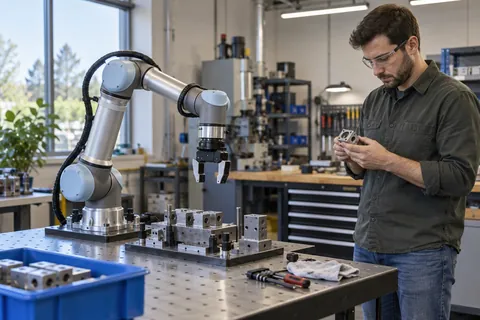
As of April 11, 2025. The February 2025 editions of ISO's industrial robot safety standards make this a timely point to revisit. For a manufacturer considering its first installation, the most useful starting document is often a description of the work, rather than a shortlist of robot brands.
Separate the robot from the application
ISO 10218-1:2025 addresses industrial robots, while ISO 10218-2:2025 addresses industrial robot applications and cells. Their public scopes distinguish the supplied robot from its integration into a working system. The second part covers the application across stages that include design, integration, commissioning, operation and maintenance.
That distinction matters commercially as well as technically. Buying an arm with relevant safety functions does not establish that a particular tool, workpiece and workstation form a suitable collaborative application. The public standard summaries are not a substitute for the complete standards or a qualified assessment of the actual installation.
A useful procurement brief should therefore describe what the human and robot each do, when their work areas overlap and what happens during abnormal operation. The word collaborative alone leaves those questions unanswered. It can describe very different arrangements, from alternating access to a workstation to tasks involving closer interaction.
For an illustrative assembly station, an operator may replenish a tray while the robot works elsewhere, then enter the shared area for a different step. That sequence presents a different design problem from continuous side-by-side handling of the same component. The intended interaction should be explicit before a supplier proposes equipment.
Select a task with a clear boundary
NIST's 2021 report on integrating collaborative robots into small and medium-sized manufacturing operations draws on discussions with experts from five Manufacturing Extension Partnership centers. It is practical experience gathered through open discussions, not a representative statistical survey of every manufacturer. Its focus on workcell selection remains useful background for an application review.
The report considers the workcell, suitable robot capabilities and integration approach together. This supports a disciplined first question: which bounded operation is causing a measurable problem? A stable loading, handling or inspection task can be described and tested more clearly than a broad instruction to automate a department.
For a hypothetical machine-loading task, the work description might start when a conforming blank enters the input location and end when the finished part is placed in its output tray. It would include orientation, gripping, machine communication and any checks needed between those points. Each omitted step risks reappearing later as manual work or integration effort.
The baseline should record what happens today. That includes completed good parts, interruptions, changeovers and the labor actually devoted to the task. A robot demonstration cannot establish an improvement if the existing process has never been measured on a comparable basis. The comparison should use the same product family and equivalent operating conditions.
Payload and reach need the real tool and part
Catalog specifications are necessary, but the application should be evaluated with the intended end effector and workpiece. As a procurement principle, the load description should include everything the arm carries, rather than only the nominal part weight. The integrator then needs to check the complete arrangement against the manufacturer's operating limits.
Reach also deserves a physical layout. An input tray, machine opening and finished-part location may each be within the arm's nominal envelope while the proposed motions remain awkward or obstructed. A layout review should account for fixtures, cables, services and the space required by people performing their own work.
Consider an illustrative part that can be presented in several orientations. A simple gripper may work reliably when the orientation is controlled, but a randomly filled bin introduces another problem to solve. The buyer should decide whether to improve presentation or add sensing and handling complexity. That choice can matter more than a small difference between arm specifications.
A sensible supplier demonstration would use representative components, including acceptable variation. A carefully selected perfect sample establishes very little about gripping oily, variable or difficult-to-present parts. The demonstration should document its preparation conditions so the factory understands what it would have to reproduce during routine production.
Safety depends on contact, geometry and access
DGUV's earlier guidance on power-and-force-limited collaborative systems explains why the geometry of tools and workpieces matters. Edges, points and trapping locations can change the consequences of contact. The document is historical technical background, not an interpretation of every requirement in the newly published 2025 standards.
Its enduring practical lesson is that the whole task needs assessment. A smooth robot arm does not make a sharp component harmless. The workbench, fixture and adjacent machine can also create hazards that are absent from a demonstration on an open stand. Any necessary protective measures should be established for the intended operation by competent specialists.
The buyer can make that assessment more useful by supplying the real operating sequence. Include replenishment, tool changes, cleaning, maintenance access and recovery from a dropped or mispositioned part. These activities should be part of the proposed application, rather than informal exceptions that operators must invent after commissioning.
Production targets should be evaluated with the agreed protective arrangement in place. A cycle time demonstrated in a different access condition may not represent the final cell. The commercial comparison needs the performance of the assessed application, including any constraints that arise from its layout and human interaction.
Measure collaboration as a complete sequence
NIST's collaborative robot performance research program, updated in March 2025, emphasizes task-oriented performance and the coordination needed between people and robots. It investigates measurement methods rather than promising a standard commercial productivity gain. That framing is useful because a collaborative task can succeed or fail through the interaction between steps.
An operator might save handling time but spend more time waiting for a shared space to become available. A robot might execute its programmed movement quickly but repeatedly pause because the upstream process presents parts inconsistently. The application review should measure those conditions instead of treating the robot's motion time as the finished production cycle.
For an illustrative trial, record good output during an ordinary run and note each interruption with its cause. Separate part-presentation problems, machine waiting, operator interaction and robot faults. This creates a more informative basis for improvement than attributing every lost minute to the arm or every successful cycle to automation.
Recovery should also be demonstrated within the assessed operating procedures. The relevant question is whether authorized staff can recognize and resolve a routine interruption using the agreed process. An installation that depends on its original programmer for every minor variation may require a different support budget than the buyer initially expected.
Build the investment case around the final cell
The purchase price should be compared with the cost of a complete working installation. A buyer's estimate can explicitly include tooling, fixtures, integration, training, validation, support and production time used for commissioning. These are budgeting categories, not an assertion that every project will incur the same costs or proportions.
Labor benefits should be described precisely. Reassigning an operator to another constrained task may have value even if headcount remains unchanged. Conversely, a station that still needs continuous attention should not be credited with eliminating an entire shift of labor. The estimate should follow the proposed staffing arrangement and the measured trial result.
A suitable first application has a clearly defined task, representative test parts, a realistic layout and an accountable integration plan. The new standards reinforce the distinction between robot and application. The manufacturing decision should follow the same logic: select and assess a complete process that can produce useful output under everyday operating conditions.
Source: ISO 10218-1/2:2025; NIST collaborative robot integration research · Cover: AI-generated illustration