Coffee traceability: keeping smallholders connected as buyer requirements grow
Coffee traceability increasingly begins with a farm map, but it cannot end there. A buyer needs a credible connection between the land where coffee was grown and the product that moves through a cooperative, processor and exporter. For smallholders, participation also depends on whether the system is affordable, understandable and useful beyond a single data-collection visit.
As of September 22, 2025. FAO’s September account of work in Kenya offers a practical example of this challenge. The initiative brings mapping tools, cooperatives and public institutions into the same conversation. Its significance lies in how those organisations may build a usable information system, rather than in the number of phones taken into a field.
What the Kenya pilot shows so far
FAO reported on 8 September that missions conducted between May and July supported coffee traceability and forest monitoring under AIM4Commodities and AIM4Forests. Kenya is one of four pilot countries named in the account, alongside Colombia, Viet Nam and Lao PDR.
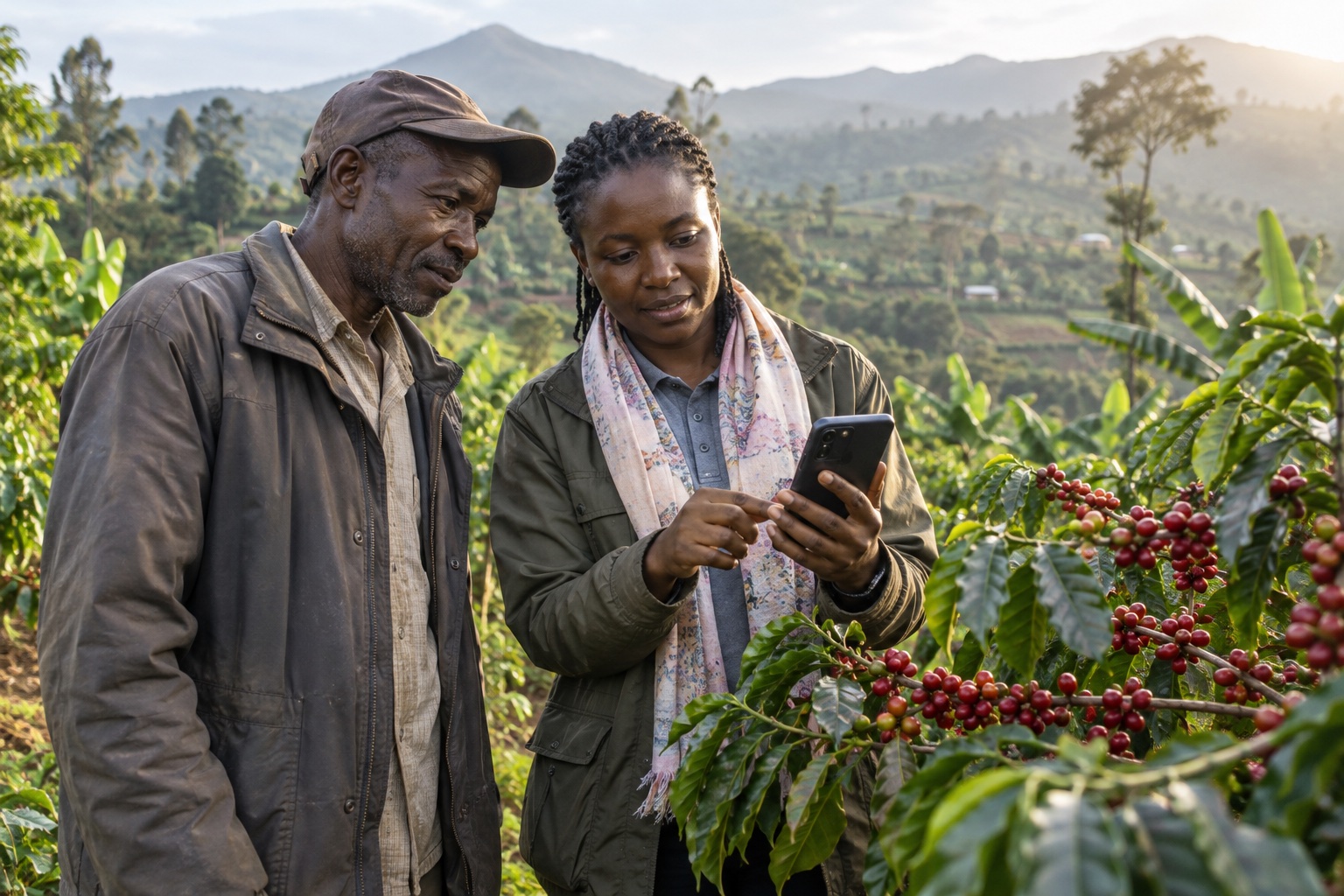
At Toroton Farmers Cooperative Society in Nandi County, forty cooperative members and extension officers took part in training that included mapping coffee plots with Open Foris Ground. The account also describes engagement with public authorities and private-sector participants around data and traceability systems.
This is evidence of pilot activity and capacity building. It is not an independent evaluation showing that every participating farmer has achieved compliance, secured a premium or increased income. Those outcomes would require separate evidence over time.
For the wider industry, the useful feature is the involvement of the cooperative and extension network. They can help connect a farmer’s record to the organisations that handle the coffee later. A mapping application on its own cannot establish that operational relationship.
The buyer’s question extends beyond location
The European Commission’s April 2025 guidance on the Deforestation Regulation explains the due-diligence context for covered commodities, including coffee. Its discussion of supply-chain complexity and certification shows why a location record or third-party certificate cannot be treated as a complete substitute for the operator’s assessment.
The guidance also distinguishes tree cover from the legal definitions of forest and agricultural use, including agroforestry. That distinction matters for coffee grown among trees. An image showing tree cover is information to interpret within the relevant definitions, not an automatic conclusion about the legal status of production.
For a cooperative, the practical challenge is to make the evidence understandable to the buyer responsible for the assessment. Plot information, production records and the movement of coffee need a coherent connection. If that connection breaks at aggregation, collecting more precise coordinates at the farm will not by itself repair it.
The article concerns preparation under the framework and guidance available in September 2025. It does not treat a pilot tool as an official certification service or assume that a mapping result settles every aspect of due diligence.
Research points to the first-mile problem
WRI’s 2023 report on traceability and transparency examines seven agricultural and forest commodities. Its methods combine desk research drawing on more than 120 reports and papers with interviews and case studies. The authors note that some case material relies on self-reported information and that the review is not an exhaustive census of all initiatives.
The report identifies challenges around indirect suppliers, fragmented information and smallholder participation. It also emphasises consistent definitions, verification and continuing support. These are findings about enabling conditions across supply chains, not a controlled trial of the Kenyan pilot.
The analytical lesson is that traceability is an ongoing service. Farm boundaries, membership, production and trading relationships can change. A system that funds initial registration but has no way to maintain records may become less useful precisely when a buyer begins relying on it.
For an exporter assessing a programme, the relevant budget therefore includes maintenance, correction and support as well as initial mapping. A low registration cost can be misleading if the resulting records require expensive reconstruction before they can support a shipment.
Connect the farmer record to the coffee movement
An illustrative cooperative receives coffee from several members, processes it and sells a combined lot. To answer an origin question later, it needs to preserve the appropriate relationships between member deliveries, processing records and the lot sold. A farmer database that never connects to receiving does not provide that history.
GS1’s traceability approach distinguishes the events that need to be recorded from the data describing them. This offers a useful general way to analyse the cooperative’s process: identify the relevant receiving, transformation and dispatch events, then determine which identifiers and records must remain connected.
The system should fit the actual trading arrangement. A smallholder may sell to different buyers at different times, and a cooperative may handle several product streams. Those realities should be represented accurately rather than forced into an assumption that one farmer always supplies one fixed export lot.
A practical pilot can follow a limited quantity through the real process and test whether the resulting answer is clear. The aim is not to collect every conceivable data field. It is to preserve enough reliable information to support the agreed claim and identify where uncertainty remains.
Inclusion needs a funded operating model
The OECD-FAO handbook on deforestation and due diligence discusses support for smallholders through capacity building, responsible purchasing, stronger producer organisations and other measures. Its approach places supply-chain responsibility with businesses as well as producers, rather than treating farmer data collection as a complete response.
That perspective matters where the immediate buyer benefit is easier to see than the farmer benefit. If a producer must spend time correcting a record, the programme should explain why it is needed, who will help and how the information affects participation. An unexplained request can become another cost imposed on an already constrained business.
A cooperative can help distribute support, but it also needs resources and clear responsibilities. Training a few staff does not establish who will maintain devices, resolve duplicate records or assist members after the initial project team leaves. Those tasks belong in the operating plan.
The buyer should also consider whether its information requests duplicate those of other customers. Where compatible standards and permissions allow reuse, a shared approach may reduce repeated work. That is an opportunity to investigate, not an assumption that every buyer’s requirements are identical.
Farmers need a way to correct the record
A traceability system should make correction a normal process. A misspelled name, mistaken boundary or wrongly linked delivery can affect how a farmer is represented to a buyer. The producer needs an accessible route to raise the issue, and the programme needs someone authorised to investigate it.
The correction should preserve an appropriate history rather than silently replacing one version with another. That helps downstream users understand whether a change affects earlier records. It also avoids a situation in which the field team, cooperative and exporter each hold a different version without knowing it.
Data access deserves similar attention. The farmer should be told what is collected, why it is collected and who will receive it. A useful system can support a buyer’s legitimate information needs while limiting unnecessary disclosure of personal or commercial details.
These are practical design questions for the programme, not claims that one specific platform has solved them. They should be tested with the people expected to use the process, including those who have limited connectivity or need assistance with the technology.
Measure participation as well as coverage
The Kenya pilot offers a starting point for examining whether shared infrastructure can make traceability more workable. The next evidence should go beyond hectares mapped or people trained: can records be updated, can a shipment be traced and can a farmer resolve an error without losing access to support?
For buyers, those measures indicate whether the information system can sustain a commercial relationship. For cooperatives, they show where staff time and funding are needed. For farmers, they make the difference between being listed in a database and being able to participate in a market that increasingly asks for verifiable evidence.
The industry’s task is to connect those interests. Reliable traceability should make the coffee’s history clearer while giving smallholders a workable way to remain part of that history.