Digital farm advice has to work beyond the phone screen
A farmer receiving a quick digital answer has gained access to information. Whether that answer improves a farm decision depends on its local relevance, the farmer's ability to use it and the support available when the situation is uncertain.
As of December 9, 2025. The World Bank's Digital Progress and Trends Report 2025 gives renewed attention to these foundations. Its agriculture discussion identifies the importance of local data and language support for AI advisory tools. The report's case-study summaries describe opportunities and constraints; they should not be treated as controlled proof that every chatbot raises yields or farm income. For agricultural service providers, the practical challenge is to build a dependable advisory relationship around the technology. A useful service should help a farmer move from a real question to an appropriate action, including occasions when the system needs more information or a human adviser. Counting generated answers alone leaves much of that journey unexamined.
Start with the decision and the person making it
Agricultural questions are rarely detached from place and timing. A request about a struggling crop can involve growth stage, recent weather, field conditions, previous treatment and the resources available to the household. A fluent answer that overlooks those details may be difficult to apply even when its general explanation is sound.
An IFPRI discussion published through CGIAR in October 2025 challenges the assumption that farmers simply have an information deficit which outside technology can fix. It emphasizes social and economic context and the knowledge systems farmers already use. This is a stakeholder-oriented discussion, not an impact evaluation of a deployed advisory product.
The implication for service design is to begin with an observed decision. What is the farmer trying to decide today? Which information is missing? What would make a recommendation feasible? Those questions can reveal that the barrier is access to an input, a market or a trusted local assessment, rather than the absence of another explanation.
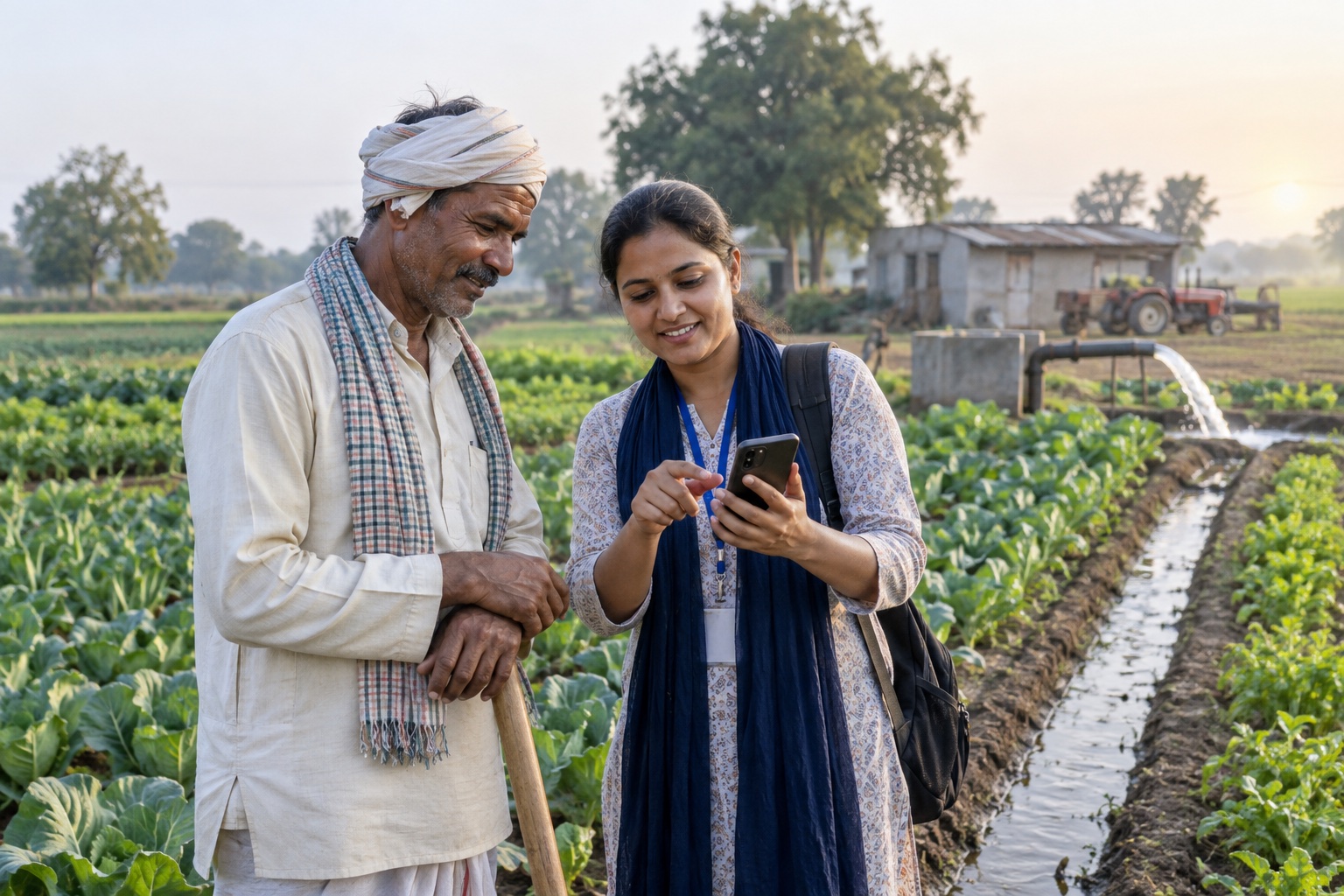
Consider an illustrative vegetable grower seeking advice about damaged leaves. A useful first interaction may ask for the crop stage and additional observations, then help arrange an extension visit if the evidence is unclear. A confident diagnosis from one poor image would create a more impressive demonstration while leaving the actual uncertainty unresolved.
Access includes time, language and assistance
The World Bank's earlier Digital Agriculture Profiles, published in 2021, describe different constraints across Argentina, Kenya, Turkey and Vietnam. Their country summaries include digital literacy, infrastructure and information flow. These are historical assessments, not current rankings, but they show why one adoption strategy cannot be assumed to fit every farming context.
FAO's 2022 State of Food and Agriculture publication overview similarly identifies literacy, infrastructure and finance among barriers to inclusive digital automation. Its scope extends beyond advisory tools. The relevant background point is that availability of a technology and practical ability to benefit from it are different matters.
For an advisory service, onboarding is therefore part of the product. Can the intended user ask a question in a familiar language? Can they understand the response without assistance? If assistance is needed, who provides it, and at what cost in time? Testing only with confident smartphone users would leave these questions unanswered.
Shared-device use also deserves direct investigation rather than assumption. The person who owns a phone may not be the person managing the relevant crop activity. A service should learn when the device is available and whether messages reach the intended decision-maker in time. These are design questions to test locally, not universal descriptions of rural households.
A useful pilot can observe the entire interaction, including failed attempts and abandoned questions. Completion time, requests for help and misunderstood instructions may reveal more about usability than a satisfaction rating collected immediately after a demonstration.
Local relevance needs a maintenance process
A locally useful answer requires more than translating a generic paragraph. The service needs an appropriate knowledge base and a process for keeping it current. It should be clear who reviews agronomic content, which locations and crops it covers, and how changes reach the system.
The practical test is whether the advice remains connected to the farmer's situation. A recommendation may depend on a product being available, on an expected weather condition or on a particular stage of crop development. If those conditions are unknown, the service should make the gap visible rather than hide it behind confident wording.
An illustrative quality review could use locally developed questions with known contextual details. Advisers would assess whether the system asks necessary follow-up questions, explains uncertainty and stays within its supported scope. The review should include difficult and incomplete queries, since real users will not always provide a neatly structured case.
When an answer is corrected, the correction should improve the service beyond that one conversation where appropriate. The team needs a way to identify recurring errors and review the underlying content or response process. Otherwise, human support becomes a repeated repair service for a problem that remains inside the system.
This is an operational responsibility. It needs an owner, review time and a budget. A pilot that relies on unusually intensive attention from its founders should explain how equivalent support will be maintained if the user base grows.
Measure outcomes along the whole advisory journey
IFPRI's July 2024 summary of research on ICT interventions in Malawi reports uneven results across districts and discusses complementary channels such as SMS, call centres and radio. The authors identify the research as not yet peer reviewed. It is evidence about a particular intervention and setting, not a trial of generative AI or a promise of equivalent results elsewhere.
For a new service, the evaluation should distinguish several stages. A message can be delivered but unread. It can be read but misunderstood. It can be understood but impossible to act on. Even an adopted recommendation may have a different outcome because of weather, prices or another constraint.
An illustrative pilot might therefore track reach, comprehension, appropriate action and a defined farm outcome separately. This helps the team locate a weak link. Low use may reflect poor timing or difficult access. Strong use with disappointing outcomes may point to the content, the recommended action or conditions beyond the service's control.
Attributing a change in income to advice requires a credible comparison, not just a before-and-after testimonial. Farms and seasons differ for many reasons. The evaluation design should reflect the question being asked and be developed with suitable research expertise before the team starts making impact claims.
Build a service that can admit uncertainty
Human support should have a defined place in the operating model. The service can specify which queries it handles routinely, which require more information and which should reach a qualified local adviser. The escalation route is useful only if someone can respond within a timeframe relevant to the farm decision.
The business model matters too. Providers should explain who funds the advice and whether commercial relationships influence recommendations. A farmer needs to understand when a service is offering general guidance, promoting a product or connecting them with a seller. Clear boundaries make the interaction easier to judge.
Data collection should be purposeful and understandable. The service should explain what information it needs for the requested help and how that information will be used. Asking for extensive farm details without an understandable benefit can add friction to an already demanding interaction.
The next useful measure of progress in digital extension is not simply how conversational a system becomes. It is whether people can obtain relevant guidance, recognize its limits and connect it with feasible action. A successful service will combine technical capability with local knowledge, accessible support and evidence from actual use. That combination gives farmers a reason to return after the novelty of the first answer has passed.